When assessing commercial market dominance, a singular question frequently surfaces across corporate boardrooms and digital networks: What is the largest law firm in the world?
The answer is not a simple one-line definition. In the modern legal sector, “size” is tracked across two distinct competitive metrics: total attorney headcount and gross annual revenue. Understanding the difference between these two categories is essential for businesses selecting legal representation and individuals tracking legal industry powerhouses.
The Billions Matrix: Dominance by Annual Revenue
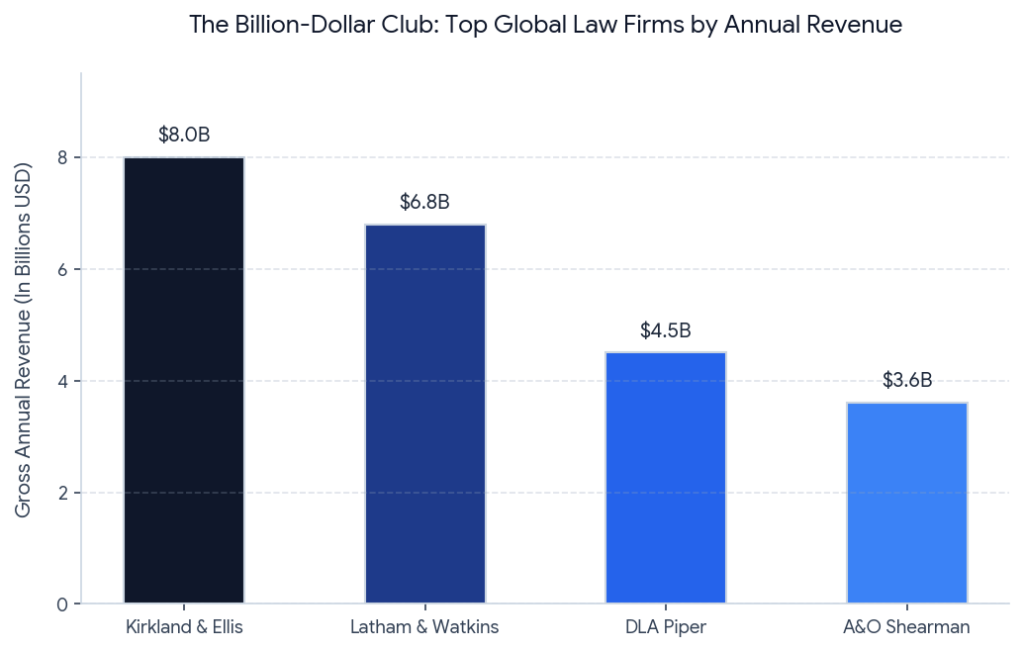
If financial performance defines scale, American-founded institutions lead the global rankings. According to recent legal market indexes, Kirkland & Ellis stands secure as the largest law firm in the world by revenue, generating over $8 billion in gross earnings. Closely following is Latham & Watkins, commanding a premium position exceeding $6.8 billion.
These firms achieve astronomical revenue figures not merely through massive staff sizes, but by securing premium elite billing rates for high-stakes corporate mergers, acquisitions, intellectual property defense, and high-stakes litigation.
The Scale Matrix: Dominance by Attorney Headcount
When evaluating the rankings purely by the sheer number of practicing lawyers, the global hierarchy shifts. Fully global networks and verein structures leverage international footprints to scale their workforces:
- Dentons: Operates a massive decentralized global model, holding thousands of attorneys across dozens of countries.
- DLA Piper: Maintains a powerful integrated presence, housing over 4,000 active lawyers across primary business hubs.
- Baker McKenzie: Holds a historic multinational footprint, deploying thousands of legal specialists worldwide.
Corporate Powerhouses vs. National Injury Alliances
While global “BigLaw” dominates international corporate finance, consumer-facing sectors operate under completely different business models. For example, national legal networks like Sokolove Law focus entirely on personal injury, product liability, and mass tort claims.
These firms do not scale through traditional hourly billing frameworks. Instead, they operate on a contingency fee model—meaning they only collect a percentage if they secure a successful client payout. For consumers fighting major corporate entities, aligning with a massive national resource network provides the leverage required to match the financial scale of global corporate legal defense teams.
Choosing the Right Scale Representation
Ultimately, the largest law firm is not automatically the ideal match for every scenario. While corporate giants excel at global commercial transactions, specialized consumer networks excel at high-volume individual advocacy. Whether navigating corporate restructuring or personal injury claims, evaluating a firm’s precise structural focus matters far more than its headcount alone.
Disclaimer & Editorial Notice: LargestLawFirm.com is an independent digital directory, media outlet, and advertising platform. The rankings, revenue statistics, headcount estimations, and firm profiles published on this page are compiled from publicly available financial disclosures, industry legal directories, historical archives, and third-party legal market indices. While we strive to maintain complete accuracy, law firm structures, partnerships, and financial data shift frequently. All information is provided for educational and general informational purposes only and does not constitute formal legal or financial advice.
LargestLawFirm.com is not a law firm, does not provide legal representation, and the submission of information through our case evaluation forms does not establish an attorney-client relationship. If you represent a law firm listed on our platform and wish to request an administrative data update or corrections, please contact our editorial team directly.